
The Craftsmanship
A craft that takes time
With us, there are no shortcuts. Every Dala horse passes through several hands, with each step requiring its own unique skill. It is work built on experience, patience, and respect for the material.
We work the same way today as we always have. Not because we have to, but because it is the best way to achieve the finest result.
How a dala horse is made

From forest to dala horse
The timber used for our Dala horses comes from the slow-growing pine forests of western Dalarna, where the climate creates dense and durable pine wood that is perfect for craftsmanship. Together with our timber supplier, Sveden Trä AB, the raw material is processed at the sawmill in Rågsveden.
Here, every piece of timber is selected by hand, based on generations of knowledge and experience. Only the very best wood is used to create Dala horses, where small knots and traces of resin are not considered flaws, but proof of genuine material and quality.
For the very smallest horses, alder wood is used, which we saw ourselves to ensure the same level of precision in every detail.
The timber is processed
From the selected timber, the wooden blanks for the horses are cut out. This is done both with a robot-assisted band saw and by hand using traditional band saws. This allows for greater precision and more consistent blanks without affecting the traditional shape or the craftsmanship that follows.
Most horse blanks are still made using the traditional method, and the greatest benefit of the robot-assisted saw is primarily for the people working in the workshop, as it provides more varied tasks for the carpentry staff.
Both methods are accepted and well established within Dala horse production, representing two technically different but equally high-quality ways of producing the same traditional blank. After this, some of the region’s most skilled woodcarvers take over, shaping each Dala horse by hand in their homes using a Morakniv knife — just as they always have.


Preparing for the painting
The carved horse is dipped in a base coat of paint. To identify any imperfections, the horse is carefully inspected before being filled and sanded smooth. After that, it is dipped one final time before being ready for decorative painting. Today, the horses are available in many different base colors, but the traditional — and most well-known — color is, of course, red.
Every horse is unique
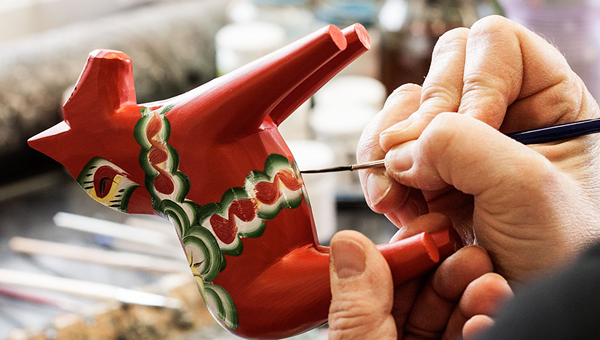
The traditional pattern found on Dala horses is called krusmålning and is closely related to kurbits painting. The decorative patterns are painted freehand by skilled artisans. The final step is to lacquer the colorful horses. Then, they are ready to leave Nusnäs and travel out into the world — not only as a symbol of Dalarna, but of all Sweden.
Explore more


Visit our Café & Shop
Shop Dala products at factory prices and enjoy lunch in our café.

Join our guided tours
Book a guided tour for an experience beyond the ordinary.